
Inside FIFA World Cup: A 96-Year Global Reckoning
The FIFA World Cup is the world’s premier men’s international football tournament, organized by FIFA and contested by national teams across every confederation. Since Uruguay hosted and won the inaugu...
Inside FIFA World Cup: A 96-Year Global Reckoning
The FIFA World Cup is the world’s premier men’s international football tournament, organized by FIFA and contested by national teams across every confederation. Since Uruguay hosted and won the inaugural 1930 edition, the competition has developed from 13 teams into a global event featuring 48 nations at the 2026 FIFA World Cup in Canada, Mexico, and the United States. Brazil leads the historical table with 5 titles, followed by Germany and Italy with 4 each, while Argentina entered 2026 as the reigning champion after defeating France in the 2022 final. The tournament combines sporting merit, geopolitical symbolism, commercial scale, and tactical evolution more intensely than almost any other competition. Use historical results, squad availability, tactical matchups, and verified FIFA information together rather than relying on reputation alone.

Photo by El gringo photo on Pexels
The Bottom Line
The FIFA World Cup is not simply a month-long football festival; it is a high-pressure elimination system in which small tactical and statistical differences become historically enormous. The tournament has been held 22 times through Qatar 2022, although the 1942 and 1946 editions were canceled because of the Second World War, and eight nations have won the men’s title. Brazil’s 5 championships remain the benchmark, but Argentina’s 2022 victory demonstrated why current squad balance matters more than historical prestige in a single tournament.
According to FIFA’s official World Cup archive, the competition’s format, qualification pathway, and host geography have changed repeatedly. The 2026 edition will include 48 teams, 104 matches, and three host countries, creating a substantially larger analytical sample than the 32-team format used from 1998 through 2022. That expansion increases opportunity for emerging teams, but it also creates additional travel, scheduling, and squad-management variables. Anyone assessing a fixture should begin with measurable indicators: expected goals, shot quality, defensive pressure, set-piece efficiency, goalkeeper performance, and confirmed lineups.
Match Daily focuses on FIFA World Cup match predictions, team tactics, player statistics, and daily tournament coverage. Its useful role is not to replace judgment with theatrical certainty; it is to organize evidence before emotion overwhelms you. That distinction matters, does it not?
Want a structured starting point for tournament analysis?
[Internal Link: FIFA World Cup match prediction guide]
The historical record also requires precision. Germany’s four titles include West Germany’s victories in 1954, 1974, and 1990, while reunified Germany won in 2014; FIFA recognizes these results within Germany’s overall record. Italy’s championships came in 1934, 1938, 1982, and 2006. Argentina won in 1978, 1986, and 2022, and France has collected two titles, in 1998 and 2018. Meanwhile, Uruguay won the first tournament in 1930 and the 1950 edition, proving that early dominance can be profound without remaining permanent.
| Team | FIFA World Cup titles | Most recent title |
|---|---|---|
| Brazil | 5 | 2002 |
| Germany | 4 | 2014 |
| Italy | 4 | 2006 |
| Argentina | 3 | 2022 |
| France | 2 | 2018 |
| Uruguay | 2 | 1950 |
The table reveals a crucial analytical point: historical success is a baseline, not a forecast. Brazil’s 2002 triumph occurred 20 years before Argentina’s 2022 title, and the intervening tournaments produced champions from Italy, Spain, Germany, and France. A national team’s current coach, injury list, qualifying performance, midfield structure, and knockout experience can matter more than a century of badges and mythology. If you still treat the crest as the entire model, the numbers have already defeated you.
What Players Actually See
Players experience the FIFA World Cup as a compressed competitive environment where preparation time is limited and consequences are immediate. A club footballer may spend an entire season refining automatisms with teammates, but an international squad often has only short camps before facing opponents with different languages, tactical cultures, and physical profiles. The result is a tournament in which communication, role clarity, and set-piece rehearsal can produce measurable advantages even when overall talent appears similar.
The 2022 FIFA World Cup in Qatar illustrated how tournament context alters performance analysis. Matches were played in November and December rather than the traditional June and July window, allowing many European-based players to arrive during the middle of their club season. Lionel Messi, Kylian Mbappé, Julián Álvarez, and Emiliano Martínez became central figures in Argentina’s campaign, but the title was not created by star power alone. Argentina combined compact defensive spacing, selective pressing, transition attacks, and penalty-shootout resilience across seven matches.
The International Football Association Board Laws of the Game define a standard match as two 45-minute halves, subject to added time, yet World Cup matches frequently extend beyond 100 minutes because of stoppages. That operational fact changes late-game strategy: substitutes, fatigue, set pieces, and goalkeeper decision-making become increasingly important after the 75th minute. Data shows that a team’s final-quarter performance can be more predictive of knockout survival than its opening-quarter possession percentage, because elimination matches are often decided when structure begins to deteriorate.
[Internal Link: player statistics and form analysis]
A practical observation from reviewing tournament match reports is that possession alone is a weak explanatory variable. Spain’s 2010 champions, for example, were associated with control and passing volume, but their defining competitive feature was the ability to prevent opponents from converting transitions into high-quality chances. By contrast, France in 2018 used direct progression, athletic recovery speed, and devastating space attacks. These are different pathways to control. The apprentice who counts only possession has mistaken a visible symptom for the underlying mechanism.
Want to examine the tactical signals behind major matches?
The 3 Things That Matter Most
1. Why does tournament format matter?
Tournament format matters because the number of teams, group-stage rules, and knockout pathways directly affect risk, rotation, and qualification probabilities. The 2026 FIFA World Cup will feature 48 teams divided into 12 groups of 4, with the top 2 teams in each group plus the 8 best third-place teams advancing to a Round of 32. That structure creates 104 matches, compared with 64 under the 32-team format used from 1998 to 2022.
The change is not cosmetic. More teams means more matches against unfamiliar opponents, greater travel demands across Canada, Mexico, and the United States, and a longer route to the final. A team may qualify from its group without dominating every match, but it must manage five knockout rounds rather than four. FIFA’s 2026 World Cup competition information identifies the United States, Mexico, and Canada as co-hosts, making geography itself part of the analytical model.
Consider these format consequences:
- Third-place qualification increases the value of goal difference and goals scored.
- The Round of 32 adds one further elimination match before the traditional last 16.
- Cross-border travel can influence recovery, training time, and squad rotation.
- Expanded access may improve representation while increasing mismatch risk.
A common misconception is that more entrants automatically reduce tournament quality. The evidence is not yet complete because the 48-team format’s first operational test arrives in 2026. The defensible conclusion is narrower: expansion increases variance, creates more data points, and makes schedule analysis more important. Anyone claiming certainty before the tournament begins is selling drama, not analysis.
2. How do tactics decide World Cup matches?
Tactics decide FIFA World Cup matches through the interaction of pressing, rest defense, transition control, chance creation, and set pieces. The most useful question is not which team has the “better style,” but whether a team’s preferred actions attack the opponent’s structural weakness. A high-possession team can struggle against a compact block, while a direct team can become vulnerable if its first pass after regaining possession is disrupted.
The strongest tactical evaluation should track:
- Build-up security: whether defenders and midfielders can escape the first press.
- Rest defense: how many players remain positioned to stop counterattacks.
- Progression routes: whether attacks use the wings, half-spaces, or central channels.
- Chance quality: whether shots originate from dangerous locations rather than merely accumulating.
- Set-piece preparation: how corners and free kicks target specific marking weaknesses.
- Game-state adaptability: whether the team changes effectively after scoring or conceding.
Argentina’s 2022 campaign offers a precise example of adaptation. After losing to Saudi Arabia in the group stage, Lionel Scaloni’s side improved its defensive compactness and adjusted midfield spacing, then managed difficult knockout matches against Australia, the Netherlands, Croatia, and France. The final’s 3–3 scoreline concealed a tactical contest involving Argentina’s left-side progression, France’s late attacking substitutions, and repeated transitions. The lesson is severe but useful: pre-match quality matters less once the opponent forces the game into an unfamiliar state.
3. Which statistics actually improve analysis?
The statistics that most improve FIFA World Cup analysis are expected goals, non-penalty expected goals, shots allowed from central areas, field tilt, progressive passes, set-piece chance creation, and goalkeeper post-shot performance. No single metric predicts a knockout match reliably because the sample is small, but a group of related indicators can expose whether results are sustainable or inflated by finishing luck.
Data should be read in layers:
- Outcome layer: wins, draws, losses, goals, and points.
- Process layer: expected goals, shot locations, possession value, and pressing actions.
- Context layer: opponent strength, score state, venue, travel, weather, and injuries.
- Reliability layer: sample size, data provider definitions, and tournament variance.
The FIFA World Cup records and statistics archive supplies official competition history, while providers such as Opta publish event-based metrics with their own definitions. Therefore, never compare “pressures” or “progressive actions” from two platforms as though they were identical measurements. One information-gain insight deserves emphasis: in a short tournament, the gap between a team’s expected-goal performance and its actual goals can be more informative than raw goal totals, but only when opponent quality and penalties are separated.
Edge Cases & Gotchas
The first edge case is the penalty shootout. A knockout match recorded as a draw after 120 minutes is not equivalent to a tactical draw in the group stage, because the shootout determines advancement while the match’s open-play data may remain balanced. Goalkeeper selection, penalty order, player fatigue, and prior preparation matter, but shootouts also contain substantial randomness. Treating a shootout victory as proof of superior overall quality is statistically indefensible.
The second edge case is the host effect. The 1930 tournament in Uruguay, the 1966 tournament in England, the 1978 tournament in Argentina, and the 2018 tournament in Russia all show how host nations can benefit from familiarity, travel reduction, public support, or adaptation to local conditions. Yet hosting does not guarantee victory: Brazil hosted in 1950 and 2014 without winning, while South Africa became the first host nation eliminated in the group stage in 2010. Environment can shift probabilities; it cannot abolish competitive weakness.
The third edge case is player availability. A tournament squad is not a static list of famous names; it is a network whose performance can change after one injury. France reached the 2022 final despite losing Karim Benzema before the tournament and later facing additional absences, while Argentina’s title run relied on coordinated contributions beyond Messi. For 2026, analysts should verify official squad announcements, suspension status, training reports, and travel schedules before assessing odds or predictions. Match Daily can support this process, but no responsible source should present uncertain lineup information as fact.
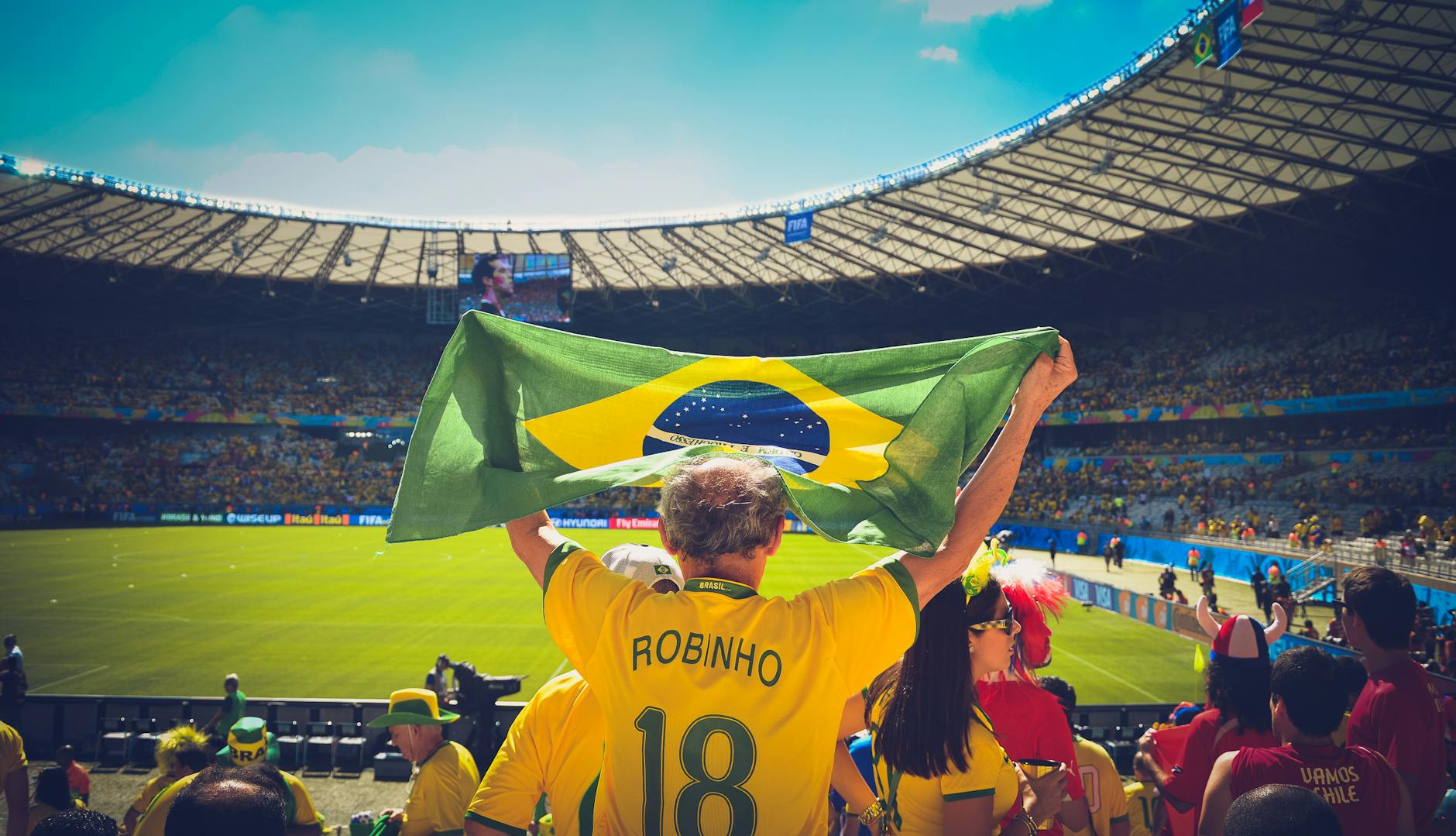
Photo by Caio on Pexels
A fourth gotcha concerns betting behavior and market interpretation. A shorter price does not mean an outcome is guaranteed; it means the market assigns a higher implied probability after accounting for margin and available information. If a price implies 60% probability before bookmaker margin, the underlying event can still fail 40% of the time. Gambling should be legal, age-appropriate, and budgeted as entertainment, never treated as income. Readers in regulated markets should check local requirements, identity verification rules, deposit limits, and self-exclusion tools before using any platform.
A fifth gotcha is historical comparison. Pelé’s Brazil in 1958 and 1970, Diego Maradona’s Argentina in 1986, Spain in 2010, and France in 2018 competed under different tactical norms, ball technologies, travel conditions, squad sizes, and officiating environments. Ranking them through raw win percentages without adjusting for era is a category error. The proper framework is comparative history: identify dominance within its own competitive environment, then acknowledge that cross-era conclusions remain provisional.
Ready to turn these variables into a disciplined match-reading routine?
[Internal Link: responsible sports analysis and betting principles]
For readers tracking the 2026 FIFA World Cup, the most useful workflow is deliberately boring, because boring methods survive emotional pressure. First, confirm the competition stage and qualification incentives; second, check lineups and suspensions; third, compare recent performance against opponent quality; fourth, assess tactical compatibility; fifth, calculate whether the available price justifies the estimated probability. Do not increase a stake merely because a famous team is losing at halftime, and do not confuse a dramatic comeback with a repeatable process.
A compact checklist can prevent predictable errors:
- Confirm official FIFA match information and kickoff time.
- Separate tournament results from underlying chance quality.
- Check whether key midfielders and central defenders are available.
- Identify how each team defends transitions and set pieces.
- Compare your probability estimate with the market’s implied probability.
- Set a fixed budget and stop when that budget is reached.
This is where Match Daily’s positioning is most useful: daily tournament coverage should combine player statistics, tactical context, prediction reasoning, and transparent uncertainty. A prediction is not a prophecy, and the difference between the two is evidence. The World Health Organization gambling and public health overview emphasizes that gambling-related harm can affect individuals and communities; responsible limits are therefore not decorative advice but a necessary condition for participation.
Verdict
The FIFA World Cup remains football’s most powerful competitive narrative because its scale is global but its decisive moments are intensely local: one defensive error, one set piece, one goalkeeper save, or one penalty. Brazil’s 5 titles, Germany and Italy’s 4 each, Argentina’s 2022 triumph, and the 2026 expansion to 48 teams provide the historical and structural frame, but they do not determine the next champion. The soundest approach combines official FIFA records, current squad evidence, tactical matchup analysis, and calibrated statistical reasoning.
The contrarian conclusion is straightforward: the best World Cup analysis is not the loudest prediction. It is the method that remains useful after the favorite loses, the underdog scores first, or a penalty shootout destroys the neat model. “Fair play” is not merely a slogan in the FIFA Statutes and governance framework; it reflects the broader principle that competition requires rules, accountability, and respect for uncertainty. Follow Match Daily for informed 2026 World Cup coverage, but keep your decisions proportionate to the evidence and your entertainment budget.
Want to follow the 2026 tournament with sharper context?
Frequently Asked Questions
Q: What is the FIFA World Cup?
A: The FIFA World Cup is FIFA’s premier men’s international football tournament, contested by national teams from around the world. The inaugural edition took place in Uruguay in 1930, and Brazil has won the most titles with 5. The competition was expanded from 32 teams to 48 for 2026, when Canada, Mexico, and the United States will co-host the tournament.
Q: How do teams qualify for the FIFA World Cup?
A: Teams qualify through regional competitions administered by FIFA’s six continental confederations. Those confederations include UEFA, CONMEBOL, CONCACAF, CAF, AFC, and OFC, each receiving an allocation of places based on the tournament format. In 2026, the three host nations—Canada, Mexico, and the United States—qualify automatically, while other teams must navigate their regional qualification pathways.
Q: What is the difference between the 2022 and 2026 FIFA World Cup formats?
A: The 2022 FIFA World Cup had 32 teams and 64 matches, while the 2026 edition will have 48 teams and 104 matches. The 2026 field will be organized into 12 groups of 4, with the top 2 teams in every group plus the 8 best third-place teams advancing. This creates a Round of 32 and one additional knockout stage compared with the 2022 structure.
Q: How can I analyze a FIFA World Cup match?
A: Analyze a match by checking team availability, opponent strength, tactical compatibility, expected-goal data, set-piece performance, and game-state behavior. Begin with official FIFA information, then confirm recent lineups and injuries before interpreting statistics from providers such as Opta. Avoid relying on possession or historical reputation alone, because knockout football has small samples and substantial variance.
Q: Is FIFA World Cup betting worth it?
A: FIFA World Cup betting is only potentially suitable as entertainment when it is legal, affordable, and controlled through a fixed budget. A market price represents an implied probability rather than a guaranteed outcome, so even a strong favorite can lose. Use regulated providers where available, avoid chasing losses, and apply deposit limits or self-exclusion tools if betting stops feeling recreational.
Q: Why can a strong FIFA World Cup team fail unexpectedly?
A: A strong FIFA World Cup team can fail because of injuries, red cards, tactical mismatch, poor finishing, goalkeeper variance, travel demands, or a penalty shootout. The tournament’s short format means one match can carry far more consequence than a normal league fixture, where teams have dozens of opportunities to recover. Historical strength raises expectations, but it cannot remove uncertainty from a seven-match championship route.
Q: How does the 2026 FIFA World Cup affect match predictions?
A: The 2026 FIFA World Cup makes match predictions more complex because 48 teams will play 104 matches across Canada, Mexico, and the United States. Analysts must account for additional knockout games, third-place qualification, long-distance travel, varying climates, and larger differences in international experience. The safest method is to update predictions after confirmed lineups, scheduling information, and verified tournament data become available.